 Community cult
The Two Faces of GRINCH
Cabal cook, or community cult? Wallets that also hold 4 other memecoins control 45.6% of supply — top 50 hold 73%. Mapped on-chain. The verdict is yours.
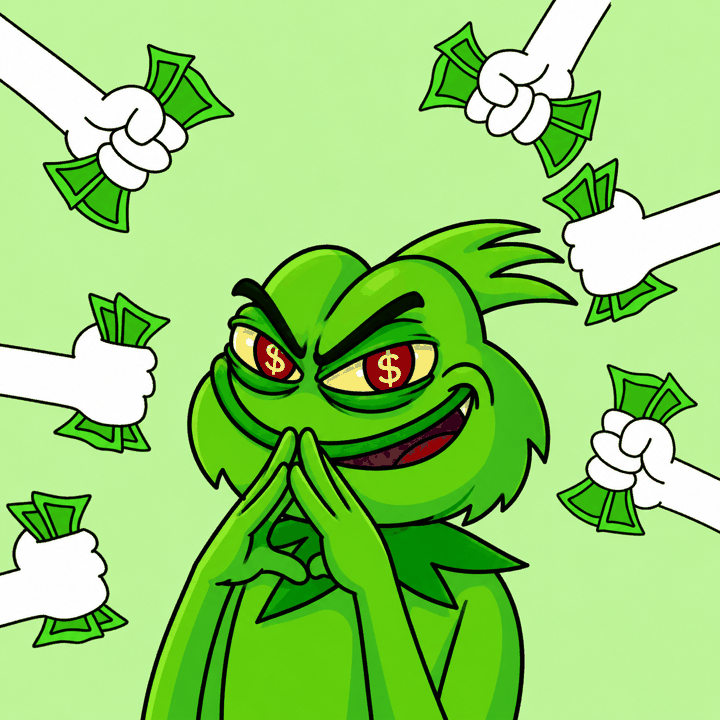 Cabal cook
Impressive volume control: cabal cook, or community cult?
GRINCH just printed new highs on Topblast tracking. Behind GRINCH's candles: wallets that also hold four other memecoins control 45.6% of supply, the top 50 wallets hold 73%, and 23 addresses cross-hold three or more of the basket — mapped from on-chain holdings and dated transfers, not vibes. We publish the math and the scenarios. The verdict is yours.
Forensic findings
Run GRINCH through the Cabal Catcher concentration scanner and a specific on-chain shape emerges: a younger meme with a tight linked-holder pattern, where the largest groups are bound by direct wallet-to-wallet transfers rather than just shared pools. GRINCH is tradable and has a community. The on-chain data simply carries a recognizable cluster signature, and that pattern is what a forensic analyst would flag.
| Signal | GRINCH |
|---|---|
| Top-10 holder concentration | 29.4% |
| Top-50 holder concentration | 73% |
| Nakamoto coefficient | 22 wallets |
| Cross-token operators | 110 wallets share the basket · 45.6% of supply |
| Largest linked holder group | 38 wallets in 16 transfer clusters |
| Linkage evidence | Direct wallet-to-wallet token transfers between members |
| Token age · pool age | Younger launch · pools fresh |
| Engine bucket | MIXED / CLUSTERED depending on threshold |
WHAT THE CHAIN SHOWS
GRINCH's largest linked group is bound by direct token transfers between members — verifiable on Tonviewer in two clicks.
THE BEAR READ
A coordinated group controlling 45.6% of supply can move liquidity, shape exit timing, or absorb buy pressure faster than a holder count alone suggests. That is the risk surface.
THE BULL READ
The same shape is also the signature of an OG community: early conviction holders who pre-sold to each other, friends-round distribution, market-making inventory rotation, or a dedicated buyer base that hasn't sold. Memecoins with tight, loyal cohorts have repeatedly outperformed tokens with broad anonymous distribution.
VERIFY YOURSELF
Open each map. Hover any cluster row to see the "why" (the engine cites the evidence). Right-click to open a member wallet on Tonviewer and confirm the transfers. Reproducible in 60 seconds — that's the whole point.
The two faces of GRINCH
Every tight cluster has two readings, and honest forensics means showing you both. Same wallets, same cross-token footprint, same 45.6% — two completely different stories.
The Community Cult read
Twenty early believers who bought together, sold to each other in the friends round, and haven't dumped through the run. Tight cohorts like this are the signature of the memecoins that actually made millionaires — conviction you can see on-chain. Under this read, the 45.6% is a moat: supply that won't hit the bid on the first red candle.
The Cabal Cook read
One operator running twenty addresses: a funder wallet feeding the others, dated transfers between "unrelated" holders, and the same crew positioned across four more memecoins they can rotate through. Under this read, the 45.6% is an exit queue — impressive volume control right up until the moment it isn't. The volume is real; the question is who's steering it.
What this means if you're trading GRINCH
Working for you
- Momentum is real — new highs on Topblast tracking with volume behind them, not a dead chart.
- 45.6% of supply in cross-token hands means less loose float to dump on you from anonymous whales — if they're long.
- The cluster has held through the run so far — the dated transfers we traced are positioning, not distribution to exchanges.
- Full transparency: every wallet and transfer is public and reproducible. You are not trading blind; you're trading informed.
Working against you
- A group that can coordinate 45.6% of supply can exit it in one move — a synchronized sell would go through the book like a truck.
- The same crew holds size across four other memecoins — 23 wallets hold three or more of the basket, 2 hold all five. That is a portfolio they can rotate through, not five unrelated bets. It's in their balances, live on the maps.
- 38 GRINCH wallets sit inside 16 transfer-linked clusters — direct wallet-to-wallet movement, not just shared pools. Cabal Catcher cites the exact transfer behind every link.
- Nakamoto coefficient of 22 — fewer than two dozen wallets control the majority, and the top 50 hold 73%.
Best case
The cluster is an OG cohort plus market-making inventory. They keep absorbing dips, the float stays tight, momentum compounds, and GRINCH does what tight-cohort memes have done before: multiply while the loose-float competition bleeds.
Watch for: cluster balances flat or growing while price rises; no outflows to CEX deposits; funder wallet stays put.
Worst case
It's one operator, and the ZOICH playbook repeats on a bigger stage: distribute into strength, rotate proceeds into the next ticker, leave the map looking like a crowd that all left through the same door at once.
Watch for: intra-cluster consolidation into 1–2 wallets (the collection-point pattern we traced on Yoda via 8936ca…); transfers out to CEX or fresh wallets; the funder bag shrinking.
Most likely
Somewhere between: a coordinated crew that is genuinely long for now — they held through the ATH push — but who manage positions across five tokens like a portfolio. They'll defend GRINCH while it's their best horse and rotate when it isn't. Trade with that assumption: ride the momentum they create, but track their wallets so their exit is not your surprise.
Watch for: which of their five tokens their fresh capital flows into next. The map updates as they move.
Every token this cluster touches — mapped
The same crew doesn't just hold GRINCH. Of GRINCH's holders, 110 wallets also hold at least one of four other memecoins; 23 of them hold three or more, and 2 wallets hold the entire basket — a pattern that does not happen by chance across unrelated tokens. Here is the basket, the cross-holding footprint, and the live map so you can watch them yourself.
| Token | GRINCH wallets that also hold it | Live map |
|---|---|---|
| Yoda (Baby Yoda) | 63 wallets | Open map → |
| ZOICH | 42 wallets | Open map → |
| EGOR | 41 wallets | Open map → |
| COIN | 39 wallets | Open map → |
Cluster balances above are live reads from the engine at publish time and will drift as the wallets move — which is the point. Open any map and the current state is what you get.
This article does not declare a verdict. A 22% linked-holder cluster is a fact about the chain. Whether that fact represents manipulation, a tight OG community, a market-maker inventory, or early friends-and-family — the on-chain trace alone cannot tell you. The job of a forensic tool is to surface the pattern. The job of due diligence is to decide what scenario you are actually in. We're publishing the math so the conversation can be grounded in evidence instead of vibes.
How to read the map
GRINCH's map shows a younger meme with a recognizable cluster shape. Infrastructure addresses (routers, pools) are cleanly excluded from the cluster math, so what remains is holder-to-holder structure. The pattern is real, the evidence is direct (wallet-to-wallet transfers between members), and the same group has shown up in related memecoin movements. Whether that is bullish or bearish depends entirely on what the cohort does next. A dedicated community is the difference between a meme that rugs and the next 100x.
Note that this is a snapshot — the underlying numbers update as new holders and transfers land on-chain. The article uses round figures; the live map at /app always shows the current state.
Check any TON token. Let the data show the pattern.
Methodology · how Intel Maps reaches these numbers
Before any cluster math runs, Intel Maps classifies infrastructure — DEX routers, liquidity-pool vaults, CEX hot wallets, launchpad escrows, sinks, and burn addresses. Shared infrastructure is not shared control. A token whose top "holder" is the STON.fi router is not a manipulated token; it's a misread.
Public-math primitives only: Gini coefficient, Herfindahl-Hirschman Index, Nakamoto coefficient, top-N share, and an infra-aware cluster pass that merges wallets bound by direct holder-to-holder transfers. Every link is cited with the exact evidence type ("direct_transfer", "shared_funder", etc.) and a confidence score. You can reproduce every claim on Tonviewer.
Intel Maps does not declare scams. A 22% linked cluster might be a market maker. It might be a friends-round distribution. It might be the next loyal-community 100x. It might also be coordination. The tool surfaces the structural fact; the trader provides the context. Always do your own research before trading. Nothing on this page is financial advice.
Notes have been shared with the GRINCH team and any tracked project that wants to clarify their on-chain distribution context. We publish on-chain math; we welcome on-chain rebuttals.