$HOODIE: What Could've Been.
The most viral launch of the Robinhood Chain frenzy put a hoodie on half of crypto X — then airdropped its entire supply to engagement, not conviction. Peak timeline. Peak chart. Then a ~94% collapse as airdropped non-holders sold into every bid.

This is the anatomy of a growth hack that worked perfectly — and destroyed its own market in the same motion. It's also a clean lesson in the one thing every launch on a brand-new chain gets wrong, and the honest, on-chain read on whether $HOODIE is a corpse or a coiled spring.
01A nine-day-old chain and a perfect costume
Robinhood Chain went live on July 1. Within a week it was doing over half a billion dollars of daily DEX volume — briefly flipping Hyperliquid — with memecoins driving roughly three-quarters of all trading. It was the loudest new-chain launch in a year, and it was starving for a mascot.
$HOODIE was the right character on the right chain at the right hour. The brown-hood wojak was instantly legible: the retail-trader-in-a-hoodie identity Robinhood itself built a brand on, rendered as a meme everyone already understood. It didn't need an explainer. It needed a distribution engine — and it found the sharpest one in crypto.
02The Bankr play: the smartest growth hack of the cycle
$HOODIE didn't launch from a website. It launched in the feed. The team used Bankr — the AI agent that deploys tokens and executes on-chain actions straight from plain-English X posts — to both mint $HOODIE on Robinhood Chain and run its entire distribution. The playbook was two lines long:
“Make the hoodie your PFP. Reply to this post.
Get airdropped $HOODIE — in-feed, for everyone to see.”
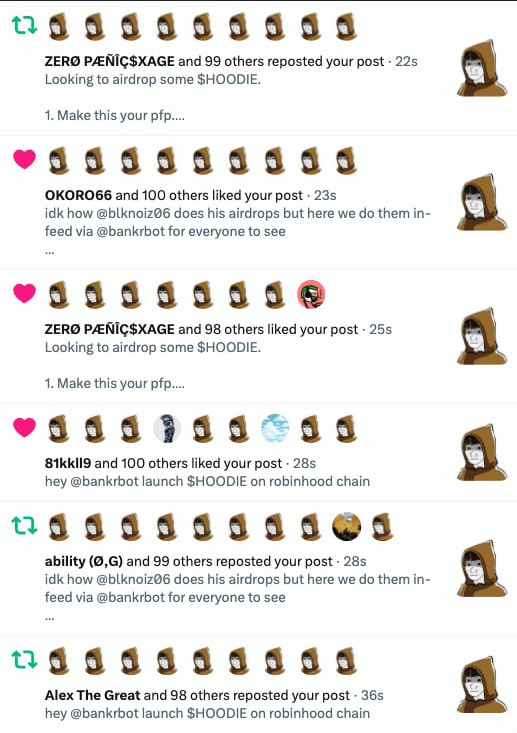
As pure marketing, it was flawless. The PFP requirement turned every participant into a walking billboard. The in-feed airdrops turned distribution itself into content — you didn't just hear about $HOODIE, you watched a hundred people get paid in real time and felt the FOMO. For one afternoon, crypto X looked like a monastery. These are engagement numbers most launches would sell a kidney for: real, organic, screenshot-able virality on a chain the whole market was already watching.
03The fatal flaw: engagement is not holding
The mechanic was missing one line of code: nobody checked who the recipients were.
The airdrop paid anyone wearing the PFP — no holder gate, no wallet-age filter, no claim step, no vesting. Hundreds of accounts that had never bought a single $HOODIE, and never intended to, received free supply. And free supply has exactly one gravitational pull: the sell button. The recipients did what airdropped non-holders always do — they sold immediately, into a bonding-curve-thin order book, all at roughly the same minute.
The chart did the only thing it could. From the post-launch high, $HOODIE collapsed roughly 94%, with independent reporting catching it halving in a single afternoon on the way down. The virality that built the top became the exit-liquidity map for the fall: the louder the timeline got, the more free supply sat in the hands of people with a zero-dollar cost basis and nothing to hold for.
04Why airdrops-to-engagement fail — structurally
This isn't bad luck; it's arithmetic. An airdrop is a transfer of supply from the treasury to a set of wallets. Whether it helps or hurts depends entirely on who's in that set:
- Reward holders and you deepen conviction — recipients are already long, and free tokens raise their average, not their urgency to sell.
- Reward engagement and you manufacture sellers — recipients have no position, no cost basis, and no reason to do anything but convert the gift to cash.
$HOODIE optimized the second one to perfection. The PFP filter selected for the most online accounts, not the most invested — and the most-online accounts are precisely the fastest to flip a free token. The growth engine and the sell pressure were the same machine.
05What the map shows now
Here's the twist nobody expects: $HOODIE now has one of the flattest distributions we index on any chain. The top ten human wallets hold 0.78% of supply combined. For scale, a healthy TON memecoin we grade A sits near 18%, and cabal-controlled tokens run 25–50%+. The airdrop didn't hand the float to a crew — it atomized it across four thousand wallets, and then the sellers walked away.
What's left is dust. But dust has one property a cabal never does: there is no single actor left with the size to dump on you. The supply overhang that kills most post-pump memecoins — a few big bags waiting to exit — structurally cannot exist here. It already left.
The live $HOODIE holder map — pools and routers excluded, refreshed continuously:
06What could've been
The tragedy of $HOODIE is that the engine worked. Swap one mechanic and the entire story inverts:
- Hold-to-earn, not wear-to-earn. Size the airdrop by existing $HOODIE balance × PFP status. Same virality — but every recipient is already long.
- Claim, don't push. A claim contract with a 7-day window filters out the pure-engagement farmers who won't even click, leaving the people who actually want in.
- Stream the drop. Vest it linearly over two weeks and the "everyone sells at once" wall physically cannot form — there's nothing to sell yet.
- Cap per account. Engagement-weighted but capped, so a hundred bot replies can't out-earn one real community member.
Any single one of those turns the loudest launch on Robinhood Chain into a durable holder base instead of a one-afternoon candle. That's the "what could've been": UTYA's distribution health with CASHCAT's reach.
07Is the bottom in — or is it over?
Best case — the reset thesis
The sellers are gone; that's mechanically what a 94% flush of zero-cost-basis supply means. What remains is a famous mascot, a proven distribution channel, and the flattest cap table on the chain. If the team — or the community — runs one more wave with a holder gate this time, $HOODIE re-rates from a base where nobody big is left to dump. The hard part (attention) is already solved.
Worst case — the attention corpse
Meme attention rarely grants second acts. The PFPs come off, the feed moves to the next costume, and $HOODIE joins the ~75% of Robinhood Chain volume that trends to zero. A flat distribution of dust is still dust if nobody comes back for it.
Most likely — the slow verdict
Chop along the bottom while the chain itself decides. $HOODIE is now a leveraged bet on Robinhood Chain's meme meta surviving its first month. Watch two numbers on the live map: whether top-10 concentration rises (quiet accumulation) and whether holder count holds above 4,000. If both hold while the chain's volume holds, the most recognizable mascot on it gets another chapter. If the frenzy fades, it fades with it.
The verdict is yours. We publish the distribution, the mechanics, and the map — the same way we did when GRINCH was printing new highs. DYOR. Ape at your own risk.
SCOPE NOTE. Holder counts, concentration, and distribution figures are Intel Maps' own live index of Robinhood Chain (walked from public chain infrastructure, refreshed continuously). Launch and airdrop mechanics are documented from the public X activity of the launch itself; drawdown is measured from the post-launch peak to the time of writing and will drift with price. The live map is the source of truth.
Watch the bottom form — or not — live.
Every wallet, pools excluded, refreshed continuously.
Sources & method
- Intel Maps Robinhood Chain index — holders, concentration, and distribution walked from public Robinhood Chain infrastructure (chain id 4663), refreshed continuously. Figures captured at time of writing.
- Public X activity of the $HOODIE launch — PFP requirement, in-feed Bankr airdrops, and engagement volume (screenshots embedded above).
- bankr.bot — the AI agent's in-feed airdrop mechanic, as documented by its own public replies on X.
- Protos — independent reporting on Robinhood Chain's first-week losses, including $HOODIE halving in a single afternoon.
- Cryptonews — Robinhood Chain DEX volume flipping Hyperliquid during launch week.
Forensic context, not financial advice. Airdrop attribution reflects publicly visible on-chain and on-platform activity; drawdown measured from post-launch peak to time of writing. We update investigations when the data materially changes.